Quick Summary
- Chronic pancreatitis can cause severe, persistent abdominal pain, particularly when pancreatic duct stones, obstruction and disease of the pancreatic head are present. In selected patients with chronic calcific pancreatitis, surgery such as the Frey’s procedure can help remove accessible pancreatic calculi, treat the diseased pancreatic head and improve pancreatic drainage.
- Because chronic pancreatitis can also affect insulin production and increase the risk of diabetes, patients may require regular blood glucose monitoring, an HbA1c test, nutritional assessment and, when needed, support from an endocrinologist. Long-term pancreatic damage can sometimes contribute to changes in blood sugar control, including hypoglycaemia and other complications.
- Robotic pancreatic surgery can support surgeons with enhanced visualisation and precise instrument control during complex procedures. At Apollo Speciality Hospital, Teynampet, Chennai, treatment is planned according to the patient’s symptoms, pancreatic anatomy and disease severity to determine whether medical, endoscopic, laparoscopic, robotic or open surgery is most appropriate.
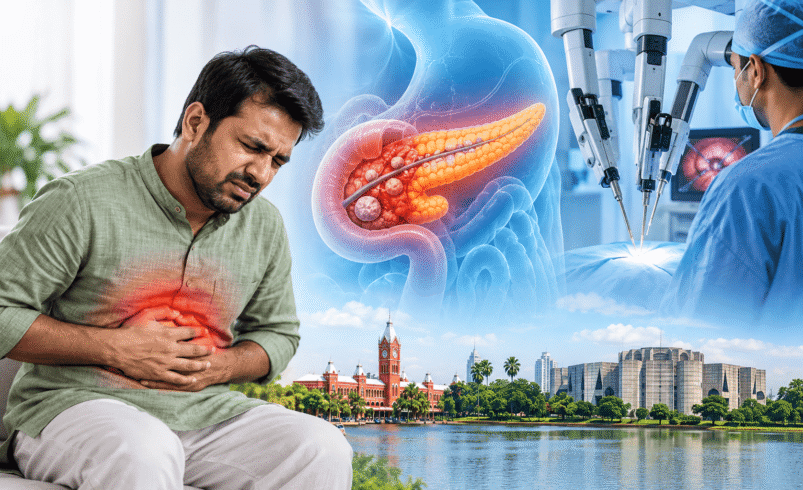
Living with chronic pancreatitis can be extremely difficult. It is a long-term disease in which repeated inflammation causes scarring and permanent structural changes in the pancreas—the organ located deep behind the stomach that helps digest food and regulate blood sugar.
For some patients, the most disabling feature is recurrent or persistent upper abdominal pain, often radiating to the back. Pain can interfere with eating, sleep, work, and everyday life and may result in repeated hospital admissions.
When chronic pancreatitis is associated with pancreatic duct obstruction, stones, and disease involving the pancreatic head, surgery can play an important role in providing durable pain relief and improving pancreatic drainage.
Why Does Chronic Calcific Pancreatitis Cause Pain?
With longstanding inflammation, calcium deposits can develop within the pancreatic duct. These are called intraductal pancreatic calculi, or pancreatic stones.
The pancreatic duct normally carries digestive secretions into the intestine. When stones and scarring obstruct this pathway, pressure can build up within the duct and contribute to pain and inflammation.
The head of the pancreas may also become enlarged and heavily scarred. In addition, chronic inflammation can affect the nerves around the pancreas, making pain more complex and persistent.
This means that a single problem does not cause chronic pancreatitis pain. Treatment needs to take into account the patient’s symptoms as well as the underlying anatomy and structural changes.
Is Surgery Really Necessary?
One of the important advances in the management of chronic pancreatitis is the recognition that surgery should not always be regarded as the final option after years of repeated endoscopic treatment.
For patients with painful obstructive chronic pancreatitis who are suitable for an operation, surgery is an established treatment, particularly when there is significant ductal obstruction or an enlarged, diseased pancreatic head. Studies comparing early surgery with an endoscopy-first approach have shown better long-term pain outcomes in appropriately selected patients.
This does not mean that every patient with chronic pancreatitis needs surgery. Endoscopic treatment remains an important option for selected patients, particularly when stones or strictures can be effectively treated endoscopically or when surgery is unsuitable. The decision should always be individualised.
A Real Patient Case
A 38-year-old patient with longstanding painful chronic calcific pancreatitis presented with recurrent abdominal pain and episodes of pancreatitis.
CT and MRCP showed a significantly dilated pancreatic duct containing multiple intraductal pancreatic calculi, together with substantial disease involving the pancreatic head.
After detailed assessment of the symptoms, imaging, and pancreatic anatomy, a robotic Frey’s procedure was performed at Apollo Speciality Hospital, Teynampet.
The operation was planned to address both the ductal stones and the diseased pancreatic head while establishing a wide drainage pathway.
What Is a Frey’s Procedure?
A Frey’s procedure is an established operation for selected patients with painful chronic pancreatitis, particularly when a dilated pancreatic duct is accompanied by significant disease in the pancreatic head.
The operation has three main components:
- Opening the pancreatic duct: The duct is opened to allow direct access to the obstructing calculi.
- Treating the diseased pancreatic head: The scarred central portion of the pancreatic head is carefully cored out while preserving as much functioning pancreatic tissue as possible.
- Creating a wide pancreaticojejunostomy: The surgeon connects the opened pancreatic duct and treated pancreatic head to a loop of the small intestine, providing a broad pathway for pancreatic secretions to drain into the intestine.
In simple terms, the operation removes the obstruction, addresses the diseased pancreatic head, and creates a new, low-resistance route for pancreatic drainage.
Why Is Careful Stone Clearance Important?
For a patient with multiple intraductal pancreatic calculi, stone clearance is an important part of the operation.
The objective is to remove accessible obstructing stones wherever this can be achieved safely. Some stones may extend into small side branches or difficult locations and may not be safely removable.
The combination of appropriate stone clearance, treatment of the pancreatic head and a wide drainage procedure is what makes a Frey’s procedure different from simply opening the pancreatic duct.
“In chronic pancreatitis with pancreatic duct stones, we aim to address the obstruction as comprehensively and safely as possible. Careful clearance of accessible calculi, treatment of the diseased pancreatic head, and creation of a wide drainage pathway are the key components of the operation.”
~ Dr. Srivatsan Gurumurthy
Where Does Robotic Surgery Fit In?
Robotic surgery is a minimally invasive surgical platform that can be particularly useful when performing technically demanding pancreatic procedures.
The pancreas lies deep within the upper abdomen, close to major blood vessels and other important structures. The robotic platform provides the surgeon with a magnified three-dimensional view and articulated instruments that allow precise dissection and suturing.
During a robotic Frey’s procedure, these capabilities can assist with:
- Precise dissection around the pancreatic head
- Identification and exploration of the pancreatic duct
- Removal of accessible pancreatic calculi
- Preservation of important surrounding structures
- Precise suturing during the pancreaticojejunostomy
The robotic system does not operate independently. Every movement of the instruments is controlled by the surgeon.
It is important to distinguish the evidence supporting pancreatic surgery from the evidence specifically comparing robotic and conventional approaches. Surgery has an established role in appropriately selected patients; robotic surgery is a platform that may provide technical advantages in selected cases, but it is not a guarantee of better outcomes.
“For me, one of the most useful aspects of robotics in pancreatic surgery is the combination of excellent visualisation and precise instrument control. This can be particularly helpful when working around the pancreatic duct and during the reconstruction after the diseased tissue and stones have been addressed.”
~ Dr. Srivatsan Gurumurthy
Expertise Matters as Much as Technology
Pancreatic surgery is technically demanding, particularly in patients with longstanding inflammation, fibrosis, and distorted anatomy.
In my practice, I use advanced laparoscopic and robotic techniques for complex gastrointestinal and pancreatic surgery, including procedures such as the robotic Frey’s procedure.
For me, the important question is not simply whether a procedure can be performed robotically. It is whether the patient’s anatomy and disease pattern make a particular operation appropriate and whether minimally invasive surgery can be performed safely and effectively.
Technology should support surgical expertise, not replace it.
Recovery and Long-Term Care
Our patient had an uncomplicated postoperative recovery, with gradual reintroduction of oral nutrition and satisfactory recovery following the procedure.

Surgery can address the structural problems responsible for pain, but chronic pancreatitis is a long-term disease, and the pancreas may already have sustained permanent damage.
Depending on the individual patient, ongoing care may include:
- Monitoring blood glucose and diabetes
- Pancreatic enzyme replacement when required
- Nutritional assessment and supplementation
- Regular clinical follow-up
- Avoidance of alcohol and tobacco
The goal is not only to treat the current episode of pain but also to provide a comprehensive long-term strategy for pancreatic health.
The Take-Home Message
For patients with painful obstructive chronic pancreatitis, surgery is an established treatment, not simply a last resort after repeated failed procedures.
A Frey’s procedure is particularly useful when significant pancreatic duct disease is associated with an enlarged or diseased pancreatic head. It combines removal of obstructing calculi, treatment of the pancreatic head and wide pancreatic drainage in a single operation.
Robotic technology can provide enhanced visualisation and instrument dexterity during this technically demanding surgery. However, the most important factors remain correct patient selection, appropriate surgical planning and experienced pancreatic surgery.
For patients from India and overseas, evaluation at a specialised pancreatic surgery centre can help determine whether medical, endoscopic, laparoscopic, robotic or open surgery is the most appropriate treatment.
The objective is simple: understand the disease, choose the right operation, and deliver it with precision and experience.
Dr Srivatsan Gurumurthy is a senior consultant surgical gastroenterologist and clinical lead for surgical gastroenterology & minimal access surgery at Apollo Speciality Hospital, Teynampet, Chennai. He holds M.S., DNB (G.I. Surgery), FMAS and FMIAS qualifications. His clinical focus includes advanced gastrointestinal, pancreatic, laparoscopic and robotic surgery. He specialises in minimally invasive approaches for complex surgical conditions.